

How We Solved Them:
Recap video by Yayasan Hasanah

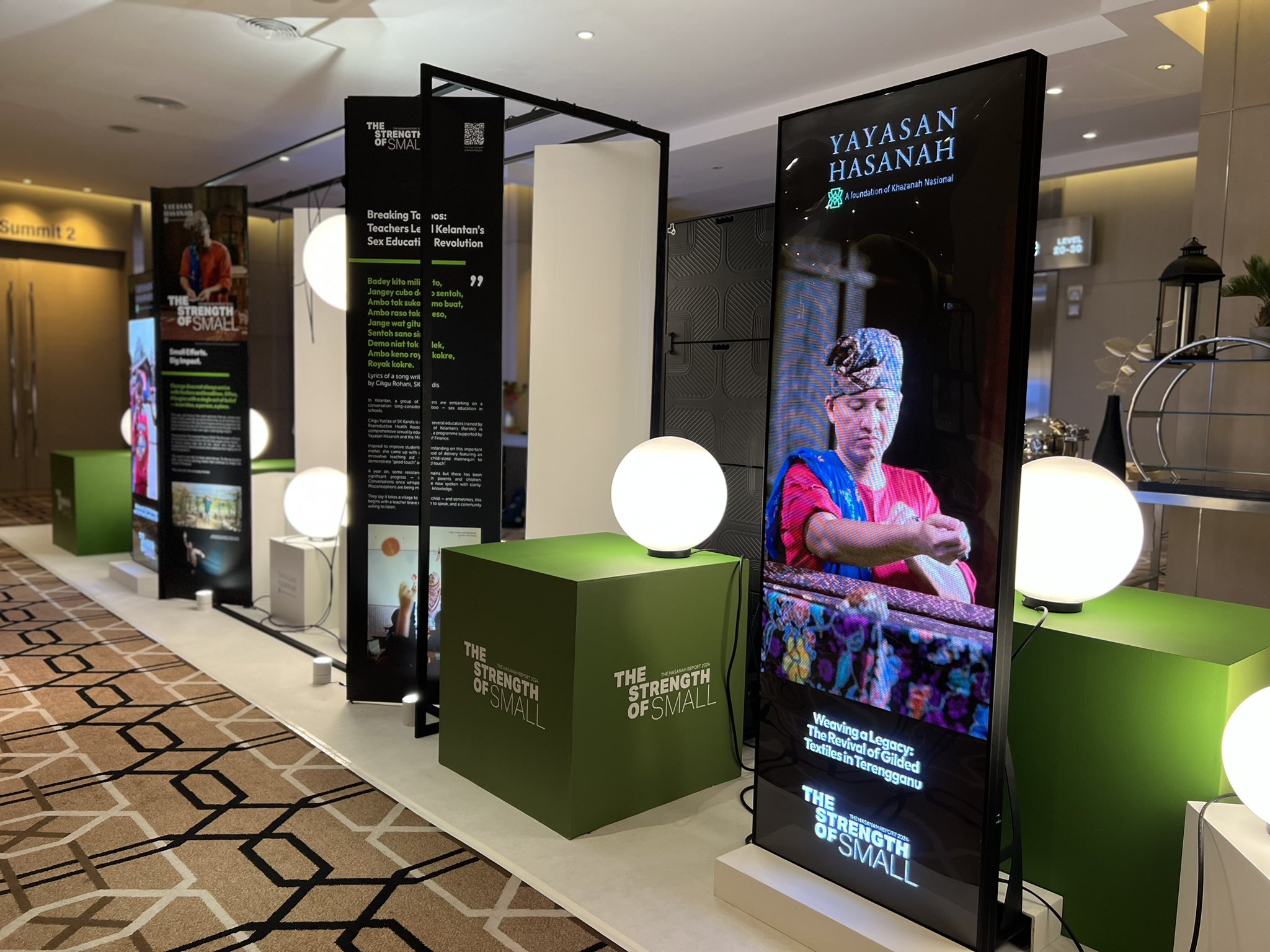
As part of Yayasan Hasanah’s tenth anniversary, Hasanah Rimba Raya was conceptualized to celebrate and share the foundation’s impactful journey with stakeholders, community members, and supporters. Yayasan Hasanah aimed to create an immersive and visually engaging event that would resonate with a diverse audience. The challenge lay in designing an experience that would not only commemorate the foundation’s achievements but also leave a lasting impression, connecting attendees to the heart of Yayasan Hasanah’s mission.
VISIOLAB’s strategy centered on creating a memorable, visually captivating event experience through:
VISIOLAB executed the project with a strong emphasis on visual storytelling and precision:
As VISIOLAB’s first event collaboration with Yayasan Hasanah, Hasanah Rimba Raya 2024 was a significant success:
VISIOLAB is proud to have partnered with Yayasan Hasanah for Hasanah Rimba Raya 2024, focusing on a compelling visual experience and impactful event management that honored the foundation’s commitment to community development.

This is a short documentary that took a month of planning and a heartfelt pitch before it got the green light.
We started our journey in the quiet of the night, leaving Cyberjaya's glowing skyline behind. Our destination was nestled deep in Pahang's embrace, where the modern world seemed to fade away. Arriving at Kuala Lipis at 3 am, we caught a few hours of rest before the real work began.
As dawn broke, we were greeted by a mesmerizing sight—the kampung waking up, a blend of tradition and the new dawn of progress. We met the acting Tok Batin, the village chief, and started to weave the story of a community being reborn through the support of Petronas.
PETRONAS had been working tirelessly, not just in Rakoh but all over Malaysia, empowering the various needy communities. They brought in solar-powered water filters, providing the villagers with a clean and constant water supply—a luxury in such remote areas. The night in Rakoh was no longer a veil of darkness; solar-powered lights now dotted the landscape, a beacon of safety and progress. Education was another cornerstone of their efforts, ensuring the villagers could maintain and grow with these new systems for years to come.
Yet, amidst this backdrop of change, we faced our own set of challenges. Language barriers and the unpredictable nature of working with children as our main actors tested our patience and creativity. But with the help of the villagers, especially one dedicated mother, we kept the shoot on track.
The documentary wrapped up later than planned, but the delay came with a silver lining—we captured the stunning sunset over a transformed village. Leaving was tough, especially when we saw our clients without a ride. So, in a spur-of-the-moment decision, we gave up our seats and hitched a ride on the back of the 4x4s, ensuring everyone got back safely.
Reflecting on those two days, "Amir and His Village" wasn't just a project; it was a profound experience. We didn't just film a story; we became a part of it, witnessing the incredible impact Petronas has had on this vibrant community. A big shout-out to the team for pulling through every hurdle with a smile.

Our video production project has two main challenges. Firstly, we need to understand and capture the essence of the national water strategy, which was developed by a diverse group of stakeholders including scientists, experts, industry players, policymakers, and thinkers. Our goal is to present this strategy in a way that is easy for a broad audience to understand, from the general public to policymakers. This means we have to explain complex ideas in simple terms and use visuals that clearly convey the main messages.
Secondly, we have to navigate a large network of stakeholders, including more than 10 agencies, 1 ministry, and various experts. We have to take into account the opinions and input from all of these stakeholders within a short 3-month production period. This involves managing different perspectives, incorporating feedback, and making sure the final video reflects the shared vision of all the stakeholders involved.
Despite these challenges, we are committed to creating a video that captures the important aspects of the national water strategy and resonates with a wide audience. We will carefully plan, communicate effectively, and work hard to overcome these obstacles and deliver a video that truly represents the transformative vision of our stakeholders.
Our project strategy to overcome these challenges involves several key approaches:
Our team of 15 mobilised to several locations in 6 days of shooting each with their own roles:
Two constraints defined this project.
The first was pace. The NPHAP is a rich framework, and the natural instinct is to explain it. In an early pass, the script ran long, and a long script pulls a launch film toward the rhythm of an explainer video. That was the wrong register for the opening of a national forum. A launch montage has to stay high-energy from the first frame to keep the audience's momentum, while still landing the gists of the plan that the room needed to hear.
The second was timeline. The film had to be concept, script, edit, graphics, and final delivery, all inside a window of under two weeks, timed precisely to the forum date. There was no room for a long production shoot or a drawn-out revision cycle.
We solved both constraints with one decision: build the film from story, not from footage days.
Because the message mattered more than new cinematography, we anchored the film on an existing footage library from our prior ASM productions, supplemented with licensed stock and original motion graphics. That removed the longest and least predictable part of any production, the shoot, and let us spend the full timeline on the two things that actually carry a launch film, which are the edit and the pacing.
On pace, we made a deliberate call to protect the 2.5-minute runtime. Where the framework got dense, the six key result areas, the five systemic shifts, the strategies and action plans, we translated it into rhythmic motion-graphic grids rather than narration, so the numbers register visually at speed instead of being read out. The voice-over was tightened to carry emotion and direction, and the data was handed to the graphics. That is how the film keeps its energy without losing the substance.
The film is structured in three movements that mirror the whitepaper's own arc.
Throughout, every frame was held to a Malaysian context, with a deliberate balance of gender and community, so the film reads as a national movement rather than a generic environmental montage. Original motion graphics, considered sound design, and a tightly edited voice-over carried the whole piece to a final runtime of two and a half minutes, delivered on schedule for the forum.
The film opened the Malaysia National Planetary Health Forum on 20 November 2025, the same event at which the NPHAP was formally introduced to the nation by MOSTI and ASM. It set the tone for a launch that placed Malaysia among a select group of countries recognised internationally for advancing science-based planetary health action.
By adapting the whitepaper directly, the film delivered the plan's core figures and principles, the six key result areas, the 53 strategies, the 222 action plans, and the four guiding principles, without slowing into an explainer. It held its energy for the full 2.5 minutes and handed the room to the speakers with momentum, not fatigue.
Let’s create and collaborate
We’re versatile multitaskers, and we thrive on a lot of projects. You've seen a few of our works that we are most proud of, and your project could be next in line.

Empowering brands with captivating visual stories, creating strong connections and growth.


.svg)
